
In the previous essays, we discussed operators and the hierarchy of Topological spaces on which they may act. Now we will begin connecting fundamental concepts from linear algebra to operator theory to build deeper intuition. We will derive the Rank-Nullity Theorem and show how it connects naturally to the Fredholm index.
Assuming we have a linear map

between vector spaces 

- The subspace
is the domain of
, describing the set of all admissible inputs to
- The image (or range) of
, the set of all outputs achieved by
- The kernel of
, the set of all inputs that map to the zero vector in
A Motivating Example
Consider the transformation:

defined by 


and

Moreover, 
In this case, 


where

and

One might ask why we do not simply take 

is defined such that

then 
Quotient Spaces
Before proving Rank-Nullity, recall that for a subspace 

and the standard result in linear algebra states:

For example, in 

representing the x-y horizontal plane where 

Then 

which can be visualized as the family of horizontal layers parallel to 
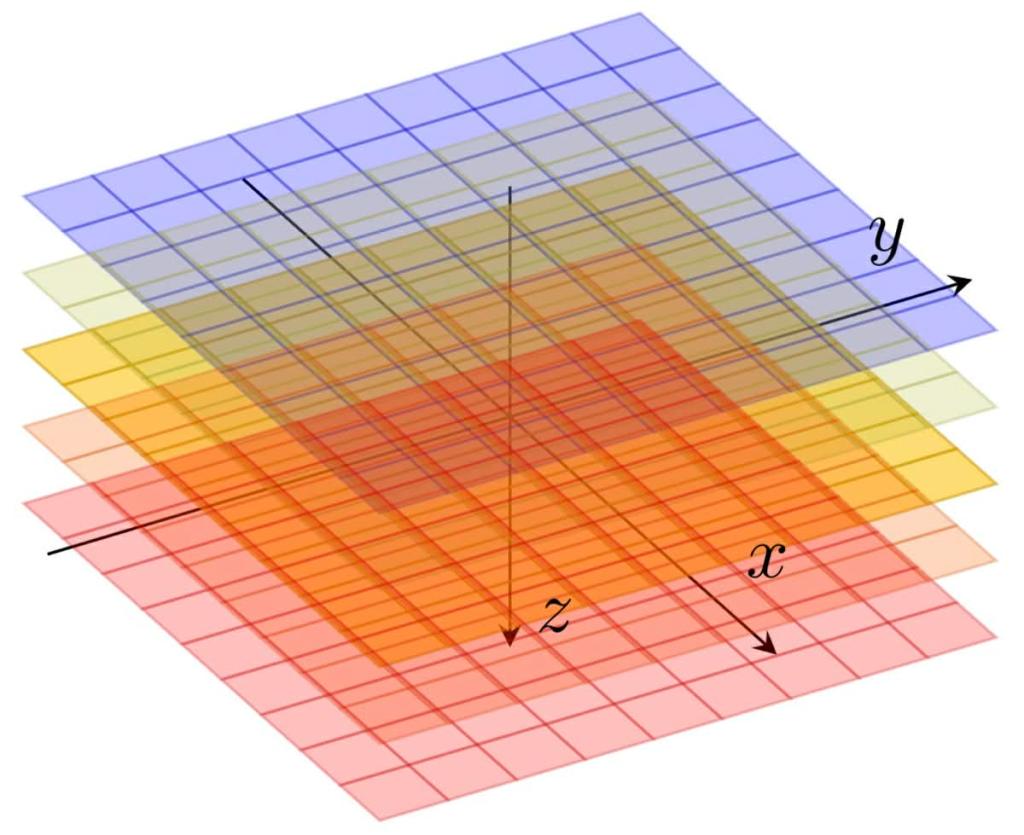
Since 

Rank-Nullity Theorem (Proof)
Let

be a linear map. By linearity, 


and more importantly,


rearranging this equation, one has


This is the Rank-Nullity theorem. Q.E.D.
The Fredholm Operator and Index
Now we should ask what proof of the rank-nullity theorem means for Operator Theory? Especially for operators where 

Again consider
When dimensions are finite, we have

Substituting 

and by rearrangement,

In infinite -dimensional settings, the left-hand side may be meaningless (as “
A bounded linear operator 


To interpret this, let 

and

One can show that 


Therefore,


The class 
 BGecko