
Part III and IV of Operation Gradient took me a while to write… not from lack of effort, but because they demanded deep introspection. At the start of this year, so much was unfolding that to offer anything less than my full focus would’ve undersold the weight of these experiences. Fortunately, both pieces are more expansive, and will be released consecutively (Part III at the start of this week, and Part IV sometime later in the week), offering you more to read, reflect on, and interpret.
When I arrived at Keesler Air Base, I was determined to make a name for myself. Knowing I’d just been handed the opportunity of a lifetime, I initially wanted to network with as many people as possible. My first task, though, was finding where I’d be staying. According to the Defense Travel System (DTS), a fully automated online system used by the DoD to manage all aspects of official travel, I was assigned to room 3310 at the Inns of Keesler, Cole Manor.
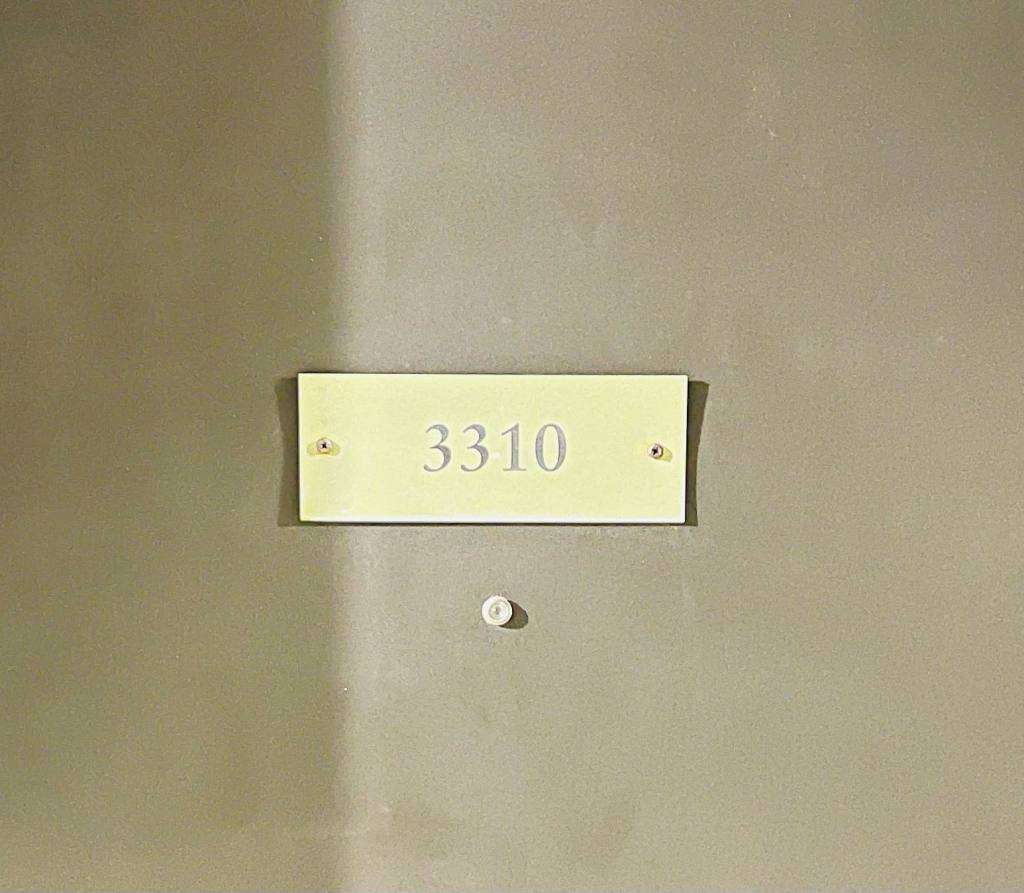
My first memory, from what I can recall, was trying to find some numerative significance for the number 3310. In hexadecimal, 3310 translates to 0xCEE, which I took as a homophonic substitution for “see.” At least now I see it as a deliberate echo of the “learn to see” quote by Leonardo Da Vinci on my homepage.
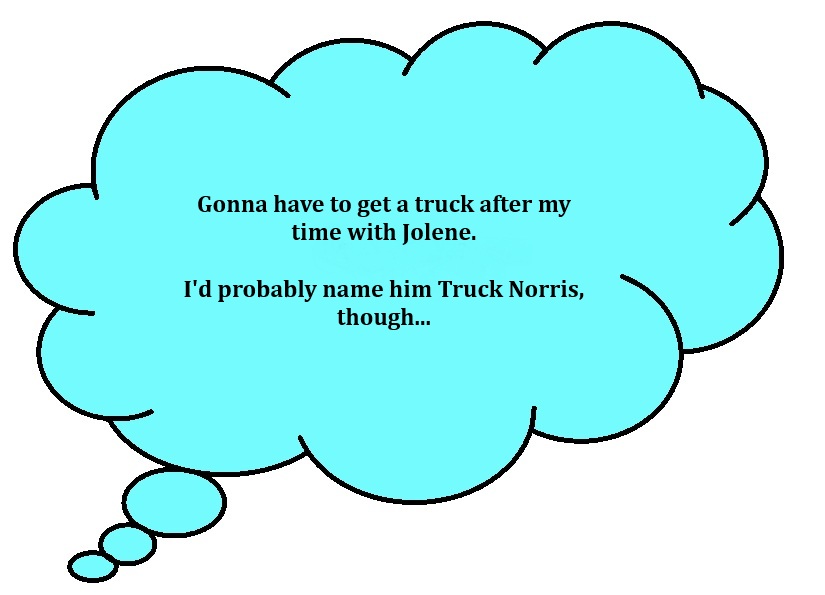
Up to that point, I had always packed lightly, so there wasn’t much to unpack. Everything I wanted to bring for sure at that point was packed into my small black 2014 Chevy Camaro (which I occasionally call Jolene). As I unpacked, I reflected on when I first purchased her nearly eight years ago. In the midst of unpacking, I ran into an older gentleman named LT Bender, who told me he was involved in the same program and wanted me to hang out with him over the remainder of the weekend.
“In a few minutes, LT Becker should be swinging by,” he said. “She’s going to be in class with us. We don’t know where we’re going to eat yet, but we’ll find a place.”
LT Bender is the kind of guy whose physical appearance is difficult to describe. It seems he wore shorts more often than long pants, and I wasn’t sure if it was for the settling heat along the Gulf coast or if it was just his style. His demeanor, however, reflected someone with deep knowledge, and frankly, whenever I saw him, he carried the demeanor which reminded me of the Intro to the Chuck TV Show.
Bender told me at one point he was a Database Engineer before pursuing a career in Operations Research. Yet he also revealed he had already worked on an OR team in the Air Force, and in our conversations, he further characterized the nature of the OR career field from an operational standpoint.
“The preliminary material is pretty mathematical, which is okay. I’m really excited about the wargaming part, though,” said Bender.
As we descended the steps from the second floor of our building, I noticed small units of Marines and Airmen marching to and from it, each carrying identical black backpacks. Hopping into Becker’s car, we talked about many things, but among them was how Keesler Air Base wasn’t just a training hub for Officers — it shaped enlisted minds too.
Becker was a married Filipina woman, who had been prior enlisted. Wearing dark square shades, signifying a cool calm demeanor, she drove us to the Carribean Grill & Seafood Kitchen — a popular spot known for its incredible jerk chicken– where we immediately began discussing the chance to move somewhere with better living conditions. While the Inns of Keesler was conveniently located on base, unfortunately palmetto bugs emerged in swarms from every crack and shadow in the courtyard as the evening fell. Of course, any change in lodging had to pass through the DTS.
The weekend passed, and we were expected to show up for class pretty early. My eyes swept across the classroom, until they settled on a Latina woman with a composed presence, focused and undistracted, wearing heart-shaped shades like a quiet gesture of individuality. I recalled the time when I had also owned a pair of heart shaped shades that I had obtained from my time at Pensacola Beach.
Mariana was a civilian living in Texas. Her father retired from the Air Force, and I think in some way this inspired her to work for the Department of Defense, after obtaining a master’s degree in mechanical engineering. Later, I learned that she was a formidable systems thinker, capable of taking on unforgivingly difficult tasks, and with creative organizing principles, she reduced them to simplicity.
I had also met LT Abi, who was originally from Puerto Rico, where he obtained his math degree. He was somewhat quieter than many of my other classmates, but his sense of humor often quickly flooded the room; his slides, at first glance, introduced a brilliant levity to many of the projects. What was really interesting to me about Lt Abi, though, was his knowledge about geography and the cultures surrounding them. In fact, Abi struck me as the type whose subtle genius might be easily misunderstood, but upon further inspection, potentially he might willingly surpass anyone.
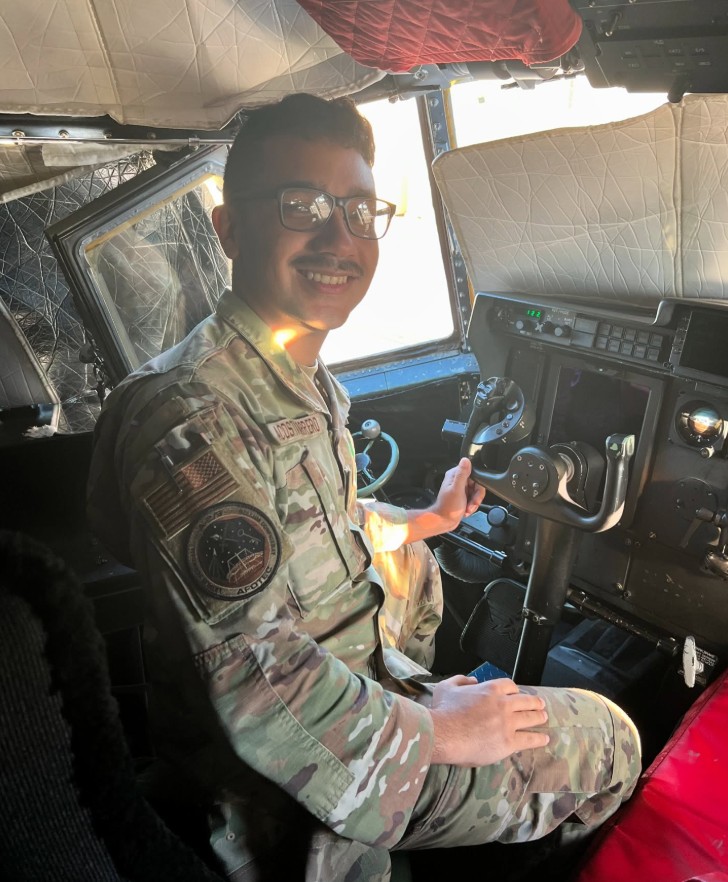
Photo of LT Abi
In most of the classrooms I have ever been in, everyone is usually quiet initially; however, the 15A classroom was different. From the start, everyone inquisitively sought to learn more about each other. In the first month of our course, we went over much of the preliminary mathematics. Talking about probability theory, statistics, linear algebra, and calculus was so much fun — at least to me, and I was interested in seeing how these concepts would be applied to Operations Research. Yet I was also curious about exploring those aspects of OR that were less focused on mathematics and more related to the practices of being an officer. Being in a class full of powerfully diverse students made this surprisingly easy.
Over the weekends, we often scheduled sessions in the mornings for reviewing the introductory material. Afterwards, we went to the Casino to practice everything we had learned from our course in probability (including the law of large numbers). I made sure to get a Corona with a lime, which helped me settle into the rhythm of the flashing lights and ringing bells.

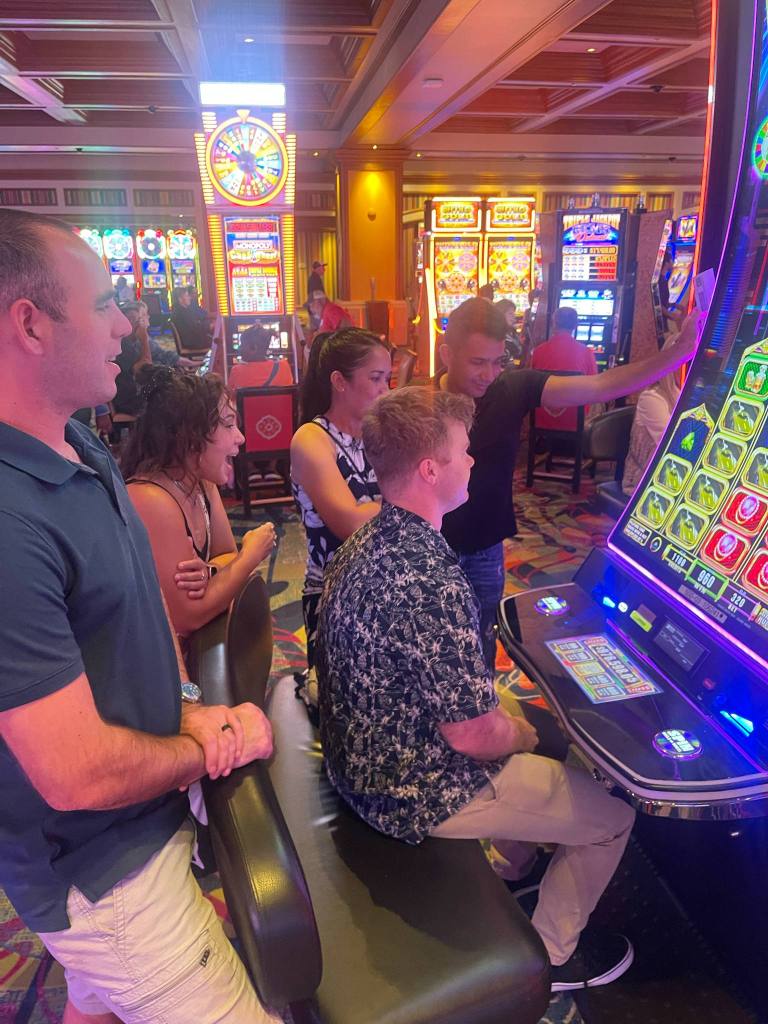

This is where I first met Captain Seth Powers (the guy sitting in the seat in the center photo above), who let out an excited holler after winning big. If Chuck Norris had a distant cousin, I figured It’d probably be Seth. Throughout our time at 15A, he consistently reflected coherence and autonomy in his decisions — qualities that, I noticed, carried naturally into his everyday life.
I remember he drove a white truck, and I thought to myself:
After the casino, we headed to the Cypress Taphouse in Ocean Springs, Mississippi, for trivia night. Although surprisingly chill winds wafted over the waters near the bridge entrance, the ducks glided past the docks, unbothered. As we arrived, the air took on a kind of mythic warmth, and it felt like life was moving in slow motion while Free Bird, by Lynyrd Skynyrd, played in the background.
 BGecko
3 thoughts on “Operation Gradient: My 15A Experience (Part III)”