
“The art of doing mathematics consists in finding that special case which contains all germs of generality.”
— David Hilbert.

The Gamma function appears in many areas of mathematics, physics, and engineering. This post will not only provide motivation for studying the Gamma function but also present several methods for deriving it, including an introduction to what is commonly known as the tabular method of integration. You may already be familiar with the factorial expression 


The factorial operation, denoted by an exclamation mark, is defined recursively; it multiplies any positive integer


… and so forth. One might then ask, how should we compute the factorial of numbers which are not necessarily whole numbers? For example, how can we compute 


Lo and behold, the brilliant mathematician Leonhard Euler introduced this function, which was later reformulated by Karl Weierstrass in the 19th century for his studies in complex analysis. The formulation originally proposed by Euler, which will be of use to us, is given by

for any positive real number 

for any positive integer
Leibniz Integral Rule
This method will appear straightforward, provided we first understand a few key identities involving higher-order differentiation. These are given below:

… and …

I will leave these formulas for the reader (yourself) to demonstrate or prove. Given these identities, we can modify the simple integral:

which I will call my reference integral. Now let us apply nth order differentiation on both sides…

By the Leibniz Integral Rule, we can rearrange the expression on the left-hand side of this equation:


… by applying the second identity, stated at the beginning of this section. If we also apply the first identity to the right-hand side, our differentiated reference integral may be rewritten…

… and by eliminating 

Hence we can see the Gamma function is demonstrated in the case when 

which is true for any positive real number
Tabular Integration
To demonstrate tabular integration, we’ll use a simple example. Let’s compute the integral of the following function…

If we let 


By cleverly aligning these values with the repeated integral values of the non-terminating function, 
| Sign | Derivatives of | Integrals of |
|---|---|---|
| + |  |  |
| – |  |  |
| + |  | |
| – |  | |
In a formal Calculus I or II setting, especially when dealing with indefinite integrals, omitting the constants of integration 

I’ve included a column of alternating signs, which is a fundamental feature of the tabular integration method. The next step is to understand how this table captures the structure of the results of our integral. Now consider the table below:
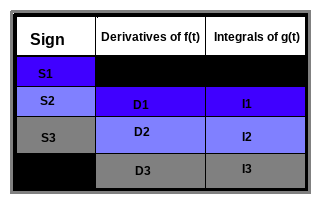
I’ve labeled the cells of this table to help you visualize the structure of the integral’s result. By overlaying this labeled table onto our original one, we can see that the indefinite integral should take the following form:


… therefore our definite integral becomes…
![\displaystyle \int \limits_{0}^{\infty} t^{2}e^{-2}dt = \lim \limits _{a \rightarrow \infty}[-2te^{-t} - 2e^{-t}]|_{t = 0}^{t = a} = 2](https://s0.wp.com/latex.php?latex=%5Cdisplaystyle+%5Cint+%5Climits_%7B0%7D%5E%7B%5Cinfty%7D+t%5E%7B2%7De%5E%7B-2%7Ddt+%3D+%5Clim+%5Climits+_%7Ba+%5Crightarrow+%5Cinfty%7D%5B-2te%5E%7B-t%7D+-+2e%5E%7B-t%7D%5D%7C_%7Bt+%3D+0%7D%5E%7Bt+%3D+a%7D+%3D+2&bg=ffffff&fg=242424&s=0&c=20201002)
which we know to be true, since

We have just confirmed our near-trivial example, using tabular integration. Below is an excerpt that details how, when we explicitly consider the constants of integration, the terms containing them cancel out:
Demonstrating Elimination of Terms with Constants (click-here):
===================================
Using our example from before, we can reconstruct the first table:
| Sign | Derivatives of | Integrals of |
|---|---|---|
| + | | |
| – | |  |
| + | |  |
| – | |  |
containing the constants 


… we can eliminate the last term here, as it contains a zero factor.
Further simplifying this expression:

… the 

Now evaluating the definite integral, we observe that the term 
![\displaystyle \int \limits_{0}^{\infty} t^{2}e^{-2}dt = \lim \limits _{a \rightarrow \infty}[-2te^{-t} - 2e^{-t} -2D]|_{t = 0}^{t = a} = 2](https://s0.wp.com/latex.php?latex=%5Cdisplaystyle+%5Cint+%5Climits_%7B0%7D%5E%7B%5Cinfty%7D+t%5E%7B2%7De%5E%7B-2%7Ddt+%3D+%5Clim+%5Climits+_%7Ba+%5Crightarrow+%5Cinfty%7D%5B-2te%5E%7B-t%7D+-+2e%5E%7B-t%7D+-2D%5D%7C_%7Bt+%3D+0%7D%5E%7Bt+%3D+a%7D+%3D+2&bg=ffffff&fg=242424&s=0&c=20201002)
==========================
Further Motivation
Interpolation of the factorial function via the Gamma function offers a broader perspective of interpolation altogether. Namely, I’ll pose the following question: given the mappings…

or

… satisfying preliminary assumptions required for interpolation, might integration serve as a general method? Proposing a family of integrable functions

which I will call the interpolation kernel, the objective is to construct an interpolating function:

(
… such that 


where 

 BGecko