
Every image you see, every song you stream, every signal being transmitted across space… at its core, it’s all just numbers. Digital Signal Processing (DSP) is a silent architect of modern technology, with widespread Industrial and Scientific applications. This series was inspired by a conversation I had with my brilliant friend Rose, motivating us to explore the fundamentals of DSP this year. As yet, there’s no better guide than the Understanding Digital Signal Processing (UDSP) book by Richard Lyons, which we will undertake, starting with its mathematical foundations. However, these notes are not meant to be all-encompassing; rather, they serve as a supplement to Lyons’s book.
Complex Numbers
On Noteworthy Forms of Complex Numbers
and their Relationship
Appendix A of UDSP briefly summarizes complex numbers and their key properties. For a freshly intuitive grasp of these fundamentals, this video offers an excellent visual and conceptual framework:
Now assuming some familiarity with complex numbers, we will interpret their Trigonometric and Exponential representations:
(Trigonometric Form)
![\displaystyle z = M [\cos{\theta} + j \sin{\theta}]](https://s0.wp.com/latex.php?latex=%5Cdisplaystyle+z+%3D+M+%5B%5Ccos%7B%5Ctheta%7D+%2B+j+%5Csin%7B%5Ctheta%7D%5D&bg=ffffff&fg=242424&s=0&c=20201002)
(Exponential Form)

The standard (rectangular) form of a complex number is 


But how can we show that the Trigonometric and Exponential forms represent the same concept? Since both forms share the same magnitude 

To demonstrate this, we revisit pertinent concepts from differential calculus. Recall the Taylor series: for any infinitely differentiable function 

where


When 
| |
|---|---|
 |  |
 |  |
 |  |
To demonstrate 


… now we’ll group the real and imaginary terms…


This fundamental result, called Euler’s formula, beautifully ties together exponential and trigonometric functions, forming the cornerstone of complex analysis and DSP.
On Conjugacy
In the context of complex numbers, the conjugate of a number reflects it across the real axis in the complex plane. Recall that 

Given
![\displaystyle z = M e^{j \theta} = M [\cos{\theta} + j \sin{\theta}]](https://s0.wp.com/latex.php?latex=%5Cdisplaystyle+z+%3D+M+e%5E%7Bj+%5Ctheta%7D+%3D+M+%5B%5Ccos%7B%5Ctheta%7D+%2B+j+%5Csin%7B%5Ctheta%7D%5D&bg=ffffff&fg=242424&s=0&c=20201002)
the conjugate can be expressed by
![\displaystyle z^{*} = M [\cos{\theta} - j \sin{\theta}]](https://s0.wp.com/latex.php?latex=%5Cdisplaystyle+z%5E%7B%2A%7D+%3D+M+%5B%5Ccos%7B%5Ctheta%7D+-+j+%5Csin%7B%5Ctheta%7D%5D&bg=ffffff&fg=242424&s=0&c=20201002)
![= \displaystyle M [\cos{- \theta} + j \sin{- \theta}]](https://s0.wp.com/latex.php?latex=%3D+%5Cdisplaystyle+M+%5B%5Ccos%7B-+%5Ctheta%7D+%2B+j+%5Csin%7B-+%5Ctheta%7D%5D&bg=ffffff&fg=242424&s=0&c=20201002)

The exponential representation of complex numbers is widely preferred, succinctly conveying both magnitude and phase. Notably, in any exponential expression 
Use Radians!
While degrees are a common unit for measuring angles, they are not dimensionless. In contrast, radians are dimensionless quantities, making them the preferred unit in mathematical expressions involving exponents. To briefly explain it in order to gain more intuition, I’ll introduce the formula for arc length

which can be rearranged to

… and we can see our angle 

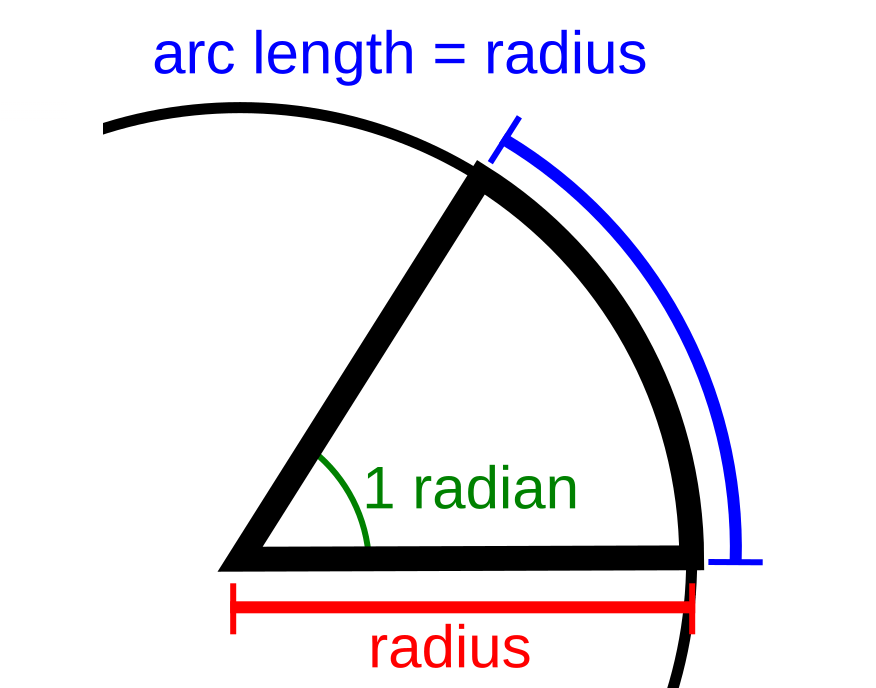
Image describing one Radian
(pulled from Wikipedia)
This is how we conceptualize one radian measure!
Complex Numbers Describe Rotations in the Complex Plane
In modern physics and engineering literature, complex numbers are often expressed in their exponential form for compactness and clarity. In DSP, where signals are time-dependent, the exponent is frequently written as 


where

The UDSP book does not explicitly define the phase angle, 


Lyons states that “the expression 

To make sense of this, here is a brief video posted by u/westbeach013 on reddit, depicting the counter-clockwise rotations of 
Geometric Series
Lyons introduced the closed-form expression of a geometric series and provided a brief explanation. However, let’s explore it further and analyze it in more detail. We were given the following closed-form expression:

… but why is it relevant? Well, this closed-form expression allows us to compute the sum of our geometric series, without needing to calculate each term individually. Before proving the closed form, I’d like to introduce a compact notation that is relevant for proving theorems about geometric series. Define 


and

Convergence of X
I will leave as a task to the reader, to demonstrate that for any whole number 

and

Therefore 
for any 


Therefore, since 

provided that


So, then another equation worth remembering would be the following:

Now we can observe the limit of this equation as 

When 


Proving the Closed-Form
Returning to the closed form expression, we can derive a simplified representation through a straightforward proof. Beginning with he summation, we arrive at its simplified form:


Up to this point, we have explored complex numbers and their properties, the significance of radians, and the closed-form expression for geometric series. In the next discussion, we will delve into logarithms and metric prefixes — along with other foundational concepts essential to digital signal processing.
 BGecko

2 thoughts on “Foundational – DSP Notes: Math Overview (Part I)”